
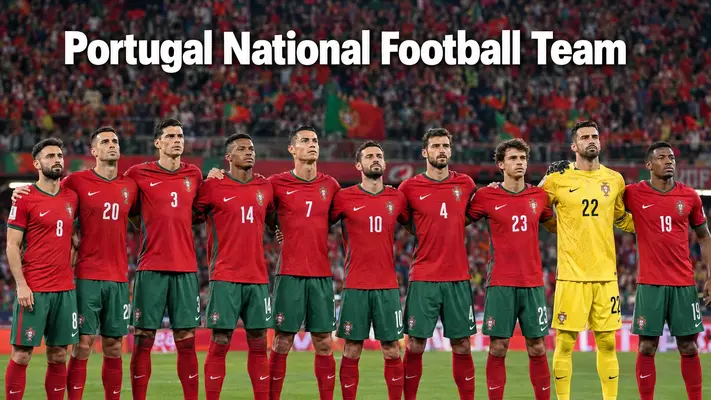
You follow football closely but struggle to find one reliable source covering every angle of Portugal’s national squad. Scattered stats and outdated articles leave you guessing about records, trophies, and current squad details. This guide solves that problem by delivering a complete, up-to-date breakdown of the Portugal national football team — from its 1921 origins to its 2026 World Cup campaign.
Key Facts About the Portugal National Football Team at a Glance
| Feature | Details |
| Governing Body | Federação Portuguesa de Futebol (FPF) |
| Manager | Roberto Martínez (January 2023–Present) |
| All-Time Top Scorer | Cristiano Ronaldo (136 goals) |
| Most Caps | Cristiano Ronaldo (217 appearances) |
| Major Trophies | UEFA Euro 2016, UEFA Nations League 2019 |
| Best World Cup Finish | 3rd Place (1966, England) |
| FIFA Ranking (2026) | Top 7 |
| Nickname | A Seleção (The Selection) |
| Home Stadiums | Estádio da Luz, Estádio do Dragão, Estádio José Alvalade |
What Is the Portugal National Football Team?
The Portugal national football team, known worldwide as A Seleção, represents Portugal in men’s international competitions. The Portuguese Football Federation (FPF) manages all squad operations and holds full membership in both FIFA and UEFA.
Fans recognize the team for its technical passing style, fierce competitive spirit, and a conveyor belt of world-class talent. From Eusébio’s 1966 heroics to Cristiano Ronaldo’s record-shattering career, the Portugal national football team has built a legacy that rivals any nation in Europe.
How Did the Portugal National Football Team Begin?
Portugal played its first official international match on December 18, 1921, losing 3-1 to Spain in Madrid. That single match launched a footballing journey spanning more than a century.
The FPF joined FIFA in 1923 and helped found UEFA in 1954. Early decades brought limited success, with the squad failing to qualify for most major tournaments. The breakthrough arrived in the 1960s when Eusébio da Silva Ferreira, a Mozambican-born striker, transformed the team overnight.
Eusébio scored nine goals at the 1966 FIFA World Cup in England and powered Portugal to a third-place finish. That tournament announced the Portugal national football team as a genuine global contender for the first time. You can explore the full historical archive at fifa.com/fifaplus/en/teams/portugal.
Who Are the Greatest Players in Portugal National Football Team History?
Portugal has produced generational talents across every position. Each era brought new icons who elevated the red and green shirt on the world stage.
All-time legendary players:
| Player | Position | Caps | Goals | Active Era |
| Cristiano Ronaldo | Forward | 217 | 136 | 2003–2026 |
| João Moutinho | Midfielder | 146 | 7 | 2005–2022 |
| Pepe | Centre-Back | 141 | 8 | 2007–2024 |
| Luís Figo | Winger | 127 | 32 | 1991–2006 |
| Nani | Winger | 112 | 24 | 2006–2017 |
| Fernando Couto | Centre-Back | 110 | 8 | 1990–2004 |
| Rui Costa | Attacking Midfielder | 94 | 26 | 1993–2004 |
| Pauleta | Striker | 88 | 47 | 1997–2006 |
| Eusébio | Striker | 64 | 41 | 1961–1973 |
Cristiano Ronaldo owns the record for most international goals and most appearances in men’s football history. His 136 goals for the Portugal national football team remain a benchmark no active player has approached. For a deeper look at his international journey, read our full Cristiano Ronaldo Portugal career profile.
The UEFA player database at uefa.com/teamsandplayers/teams/association=por provides verified statistics for every capped player.
What Trophies Has the Portugal National Football Team Won?
For most of its history, Portugal carried the painful label of “nearly men.” That narrative ended decisively in 2016 and 2019 when the squad captured two major titles in three years.
Major international trophies:
- UEFA European Championship: 2016 (France)
- UEFA Nations League: 2019 (Portugal)
The Euro 2016 victory remains the defining moment. Portugal defeated host nation France 1-0 in the final at Stade de France. Éder struck the winner in the 109th minute after Cristiano Ronaldo left the pitch injured in the 25th minute.
The 2019 Nations League triumph added a second trophy. Portugal beat the Netherlands 1-0 in Porto, with Gonçalo Guedes scoring the decisive goal. These victories permanently changed how the world views the Portugal national football team.
Portugal National Football Team World Cup Record
Portugal has qualified for eight FIFA World Cup tournaments. The squad’s best result remains the third-place finish at the 1966 edition in England.
Complete World Cup history:
| Year | Host Nation | Result | Top Performer |
| 1966 | England | 3rd Place | Eusébio (9 goals) |
| 1986 | Mexico | Group Stage | Fernando Gomes |
| 2002 | South Korea / Japan | Group Stage | Luís Figo |
| 2006 | Germany | 4th Place | Maniche, Cristiano Ronaldo |
| 2010 | South Africa | Round of 16 | Cristiano Ronaldo |
| 2014 | Brazil | Group Stage | Cristiano Ronaldo |
| 2018 | Russia | Round of 16 | Cristiano Ronaldo |
| 2022 | Qatar | Quarterfinals | Bruno Fernandes, Gonçalo Ramos |
The 2006 campaign in Germany brought Portugal closest to a second podium finish. The squad reached the semifinals before losing to France and then falling to Germany in the third-place playoff.
Why Euro 2016 Changed Everything for Portugal
Euro 2016 represented a seismic shift for Portuguese football. The Portugal national football team entered the tournament carrying 95 years of major-trophy drought.
Coach Fernando Santos built a defensively disciplined unit that prioritized structure over individual flair. Portugal drew all three group-stage matches yet advanced as one of the best third-place finishers. Critics dismissed the squad, but the players kept grinding out knockout wins against Croatia, Poland, and Wales.
The final against France tested every ounce of collective resilience. Ronaldo suffered a knee injury early and left the field in tears. His teammates held firm, and Éder’s extra-time strike delivered the most emotional moment in the nation’s sporting history. That night in Saint-Denis turned a generation of “what ifs” into permanent glory.
Who Leads the Portugal National Football Team in 2026?
Roberto Martínez has managed the Portugal national football team since January 2023. The Spanish-Belgian coach arrived with a proven track record that includes guiding Belgium to third place at the 2018 World Cup.
Martínez inherited a squad navigating a generational transition. Cristiano Ronaldo continues to captain the side, but a wave of younger talent now shares the spotlight. The coach successfully blended experience with youth by integrating João Neves, Vitinha, and Rafael Leão into key roles during the 2024–2026 qualifying cycle.
Core 2026 squad members:
- Cristiano Ronaldo – Captain, all-time top scorer (Al Nassr)
- Bruno Fernandes – Creative midfield hub (Manchester United)
- Bernardo Silva – Versatile playmaker (Manchester City)
- Rafael Leão – Explosive left winger (AC Milan)
- Rúben Dias – Defensive anchor (Manchester City)
- João Neves – Rising midfield star (Paris Saint-Germain)
- Vitinha – Tempo controller (Paris Saint-Germain)
- Diogo Costa – First-choice goalkeeper (FC Porto)
For a closer look at how Bruno Fernandes drives this midfield, check out our detailed Bruno Fernandes international career breakdown.
Portugal National Football Team Playing Style and Tactics
Portugal traditionally favors a possession-driven, technically fluent approach. The squad builds attacks through quick short passing, intelligent off-ball movement, and individual creative brilliance.
Under Martínez, the team operates primarily in a 4-3-3 formation that morphs into a 3-2-5 shape during sustained attacking phases. Full-backs push high to stretch defenses, while the midfield trio dictates tempo through rapid combinations. This system unleashes high-volume creators like Bruno Fernandes and Bernardo Silva into advanced half-spaces, giving them freedom to thread through-balls or shoot from distance.
The Portugal national football team also thrives on devastating counter-attacks. Players like Rafael Leão and Pedro Neto possess the pace and dribbling skill to transition from deep defense to a goal-scoring chance within seconds. This dual-threat identity makes Portugal dangerous against both low-block and high-press opponents.
Defensively, Martínez employs a compact mid-block that compresses central channels and forces opponents wide. Rúben Dias organizes the backline with aggressive positioning, while Diogo Costa’s shot-stopping ability provides a reliable last line of defense.
How Does Portugal Compare to Other European Giants?
Portugal sits firmly among Europe’s elite football nations. Two major trophies place the squad behind historical powerhouses like Germany, France, and Spain, but ahead of several traditionally strong footballing countries.
Head-to-head trophy comparison (2026):
| Nation | World Cups | European Championships | Nations League | FIFA Ranking |
| Germany | 4 | 3 | 0 | Top 15 |
| France | 2 | 2 | 1 | Top 3 |
| Spain | 1 | 4 | 1 | Top 2 |
| Italy | 4 | 2 | 0 | Top 10 |
| Portugal | 0 | 1 | 1 | Top 7 |
| England | 1 | 0 | 0 | Top 5 |
Portugal’s consistency in reaching the knockout stages of every major tournament since 2000 validates its elite status. The Portugal national football team has maintained a top-10 FIFA ranking for the better part of two decades.
Portugal National Football Team All-Time Records
Portugal and its players hold several remarkable records in international football. These milestones reflect sustained excellence across multiple generations.
Key team and individual records:
- Most international goals (men’s): Cristiano Ronaldo – 136 goals
- Most international caps (men’s): Cristiano Ronaldo – 217 appearances
- Most goals in European Championship history: Cristiano Ronaldo – 14 goals
- Most European Championship appearances: Cristiano Ronaldo – 30 matches
- Longest unbeaten run: 14 consecutive matches (2016–2017)
- Most consecutive World Cup qualifications: 6 tournaments (2002–2022)
- Biggest victory: 8-0 vs. Liechtenstein (2023)
- Most goals in a single calendar year: 20 goals by Cristiano Ronaldo (2019)
These achievements underscore why the Portugal national football team commands deep respect across every footballing continent. The Rec.Sport.Soccer Statistics Foundation maintains verified historical data at rsssf.org/tablesp/port-intres.html.
Where Does the Portugal National Football Team Play Home Matches?
Portugal rotates home fixtures across several modern stadiums rather than using a single national venue. This approach gives fans in different cities the chance to watch live international football.
Primary home stadiums:
- Estádio da Luz (Lisbon) – 64,642 capacity – Home of SL Benfica
- Estádio do Dragão (Porto) – 50,033 capacity – Home of FC Porto
- Estádio José Alvalade (Lisbon) – 50,095 capacity – Home of Sporting CP
- Estádio Municipal de Braga (Braga) – 30,286 capacity
- Estádio Nacional do Jamor (Oeiras) – 37,593 capacity
The Estádio da Luz hosts the highest-profile fixtures, including World Cup qualifiers and Nations League matches. The atmosphere during a Portugal national football team home game ranks among the loudest and most electric in European football. If you plan to attend a match, our guide to Portugal’s best football stadiums covers ticketing, transport, and seating tips.
Portugal National Football Team 2026 World Cup Outlook
The 2026 FIFA World Cup in the United States, Canada, and Mexico represents Portugal’s most realistic chance yet to capture a first World Cup title. The expanded 48-team format introduces 12 groups of four, and Portugal secured qualification by finishing top of their UEFA qualifying group with a dominant campaign.
Martínez’s tactical setup gives Portugal a genuine edge. His 3-2-5 in-possession system overloads the final third with five attacking players, creating numerical advantages that overwhelm organized defenses. Bruno Fernandes operates as the primary chance creator from the right half-space, while Bernardo Silva drifts centrally to link play between midfield and attack. This structure generated an average of 2.8 goals per game during the qualifying rounds.
The post-Ronaldo transition plan is already in motion. While the captain remains a lethal finisher at 41, Martínez has gradually shifted the creative burden to younger players. João Neves controls the midfield tempo with a maturity well beyond his years. Vitinha provides progressive passing from deep positions. Rafael Leão stretches defenses with direct wing play that opens space for teammates.
2026 World Cup key details for Portugal:
- Tournament dates: June 11 – July 19, 2026
- Host nations: United States, Canada, Mexico
- Format: 48 teams, 12 groups of four, top two plus eight best third-place teams advance
- Portugal’s qualification: Secured via UEFA Group stage, finished first in their qualifying group
- Key rivals to watch: France, Spain, Argentina, Brazil, England, Germany
If Portugal navigates the group stage cleanly, a deep knockout run is entirely realistic. The squad has the depth, tactical flexibility, and winning mentality to chase its first-ever World Cup title on North American soil. For the full match-by-match schedule and group analysis, read our complete 2026 World Cup Portugal preview.
Frequently Asked Questions
1. How many World Cups has the Portugal national football team won?
Short answer: Zero.
Portugal has never won a FIFA World Cup. The team’s best result is a third-place finish at the 1966 World Cup in England, powered by Eusébio’s nine goals. Portugal also reached the semifinals in 2006, finishing fourth. The 2026 tournament in North America offers the next realistic opportunity to break this drought.
2. Who is the all-time top scorer for the Portugal national football team?
Short answer: Cristiano Ronaldo with 136 goals.
Cristiano Ronaldo holds the record for the most goals in men’s international football history. He surpassed Iran’s Ali Daei (109 goals) in September 2021 and continues to extend the record. No other active player comes close to matching his tally.
3. When did the Portugal national football team win its first major trophy?
Short answer: July 10, 2016.
Portugal won UEFA Euro 2016 by defeating host nation France 1-0 in the final at Stade de France. Éder scored the only goal in the 109th minute of extra time. This victory ended a 95-year wait for a major international trophy.
4. Who is the current coach of the Portugal national football team?
Short answer: Roberto Martínez.
The Spanish-Belgian manager took charge in January 2023 after Fernando Santos departed following the 2022 World Cup. Martínez previously managed Belgium to a third-place World Cup finish in 2018. He has guided Portugal through a successful 2026 World Cup qualifying campaign with an attacking 3-2-5 system.
5. What is the Portugal national football team’s FIFA ranking in 2026?
Short answer: Top 7 globally.
Portugal has maintained a consistent top-10 FIFA ranking for nearly two decades. The team peaked at No. 3 in both 2010 and 2017. Strong qualifying performances and Nations League results keep the squad firmly among the world’s elite.
6. How many Portugal national football team players play in the Premier League?
Short answer: Over 10 players regularly feature in the English Premier League.
Stars like Bruno Fernandes (Manchester United), Bernardo Silva (Manchester City), Rúben Dias (Manchester City), Diogo Jota (Liverpool), and João Cancelo have all represented Portugal while competing in England. The Premier League serves as a major talent pipeline for the national squad.
Your Next Move as a Portugal Football Fan
The Portugal national football team has transformed from a small nation with outsized dreams into a proven global powerhouse. Two major trophies, a record-breaking captain, and a youth system producing elite talent year after year guarantee that A Seleção’s best chapters may still be unwritten.
Bookmark this guide and share it with fellow fans who want a complete, current understanding of Portuguese football. The 2026 World Cup is here — and this squad has every tool needed to make history.
What is your favorite Portugal football memory? Drop it in the comments and join the conversation.