
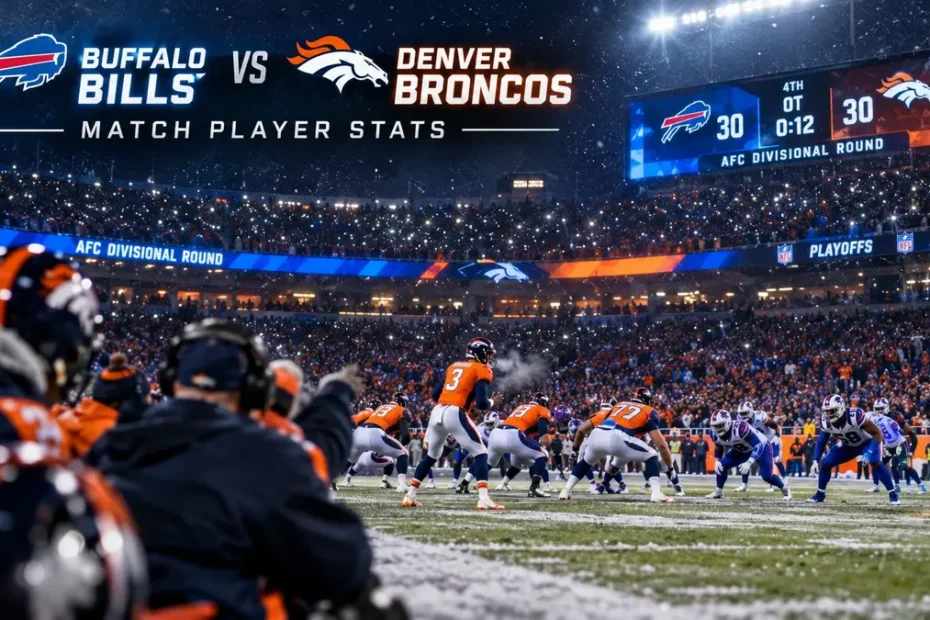
Game at a Glance — January 17, 2026 AFC Divisional Round
- Final Score: Denver Broncos 33, Buffalo Bills 30 (OT)
- Game Winner: Wil Lutz 23-yard field goal after Ja’Quan McMillian’s OT interception
- Top Passer: Josh Allen — 25/39, 283 yards, 3 TD, 2 INT
- Top Rusher: James Cook — 24 carries, 117 yards
- Top Receiver: Marvin Mims Jr. — 8 catches, 93 yards, 1 TD
- Key Stat: Buffalo lost 5 turnovers; Denver lost only 1
You want reliable numbers from this wild AFC Divisional playoff game, but most box scores scatter the data across cluttered layouts and confusing sub-pages. Piecing together turnover counts and overtime drives from multiple apps wastes your evening and leaves you guessing. This guide organizes every critical buffalo bills vs denver broncos match player stats (Bills vs Broncos match Player Stats) line into clean tables and clear takeaways so you understand exactly how Denver pulled off a 33-30 overtime upset on January 17, 2026.
A Quick Look at the Rivalry (Bills vs Broncos match Player Stats)
The Bills and Broncos have clashed more than 40 times since their first AFL meeting in 1960. Denver holds a narrow edge in the all-time regular-season series, but Buffalo owns the most famous postseason chapter — a gritty 10-7 win in the 1991 AFC Championship Game that launched the Bills to Super Bowl XXVI.
When you study the buffalo bills vs denver broncos match player stats across decades, altitude and defensive identity consistently shape the outcomes. Denver’s home-field advantage at Mile High forces visiting offenses to adjust their conditioning and tempo. Buffalo’s physical running game and aggressive edge rush create problems for Denver’s offensive line in Orchard Park.
The modern chapter features Josh Allen against Denver’s evolving defensive fronts. Allen has posted big numbers in most career matchups against the Broncos, but this January 2026 playoff meeting flipped the script in ways nobody predicted.
For a complete historical database of every meeting between these franchises, Pro Football Reference tracks every snap and score going back to the AFL era.
The Most Recent Matchup: January 17, 2026 Narrative Summary
The AFC Divisional Round delivered an instant classic. Denver defeated Buffalo 33-30 in overtime at a deafening home stadium, advancing in the playoffs behind a poised performance from second-year quarterback Bo Nix and a defense that forced five Buffalo turnovers.
Buffalo moved the ball relentlessly. Josh Allen threw three touchdown passes and added 66 rushing yards on 12 carries, extending drives with his legs and keeping Denver’s defense off-balance all night. James Cook pounded the rock for 117 yards on 24 carries, giving the Bills a dominant ground game that controlled the clock for over 40 minutes.
The problem was the football itself. Allen threw two interceptions and lost two fumbles. The Bills coughed up five total turnovers, handing Denver short fields and extra possessions at the worst possible moments. Nix capitalized on these mistakes, throwing for 279 yards and three touchdowns of his own while spreading the ball to Marvin Mims Jr., Courtland Sutton, Lil’Jordan Humphrey, and even offensive lineman Frank Crum on a goal-line trick play.
The game reached overtime tied 30-30 after Matt Prater nailed a clutch 50-yard field goal for Buffalo with 10 seconds remaining in regulation. In overtime, Denver cornerback Ja’Quan McMillian intercepted Allen on Buffalo’s drive, giving the Broncos possession inside the red zone. Wil Lutz drilled a 23-yard field goal moments later to seal the 33-30 victory.
The full buffalo bills vs denver broncos match player stats tell a story of explosive Buffalo offense undermined by catastrophic ball security and disciplined Denver execution when it mattered most.
Team Totals and Efficiency Comparison
Both offenses moved the ball, but the turnover column decided the game.
| Category | Buffalo Bills | Denver Broncos |
| Final Score | 30 | 33 (OT) |
| Total Offensive Yards | 449 | 349 |
| Passing Yards (Net) | 266 | 279 |
| Rushing Yards | 183 | 70 |
| First Downs | 28 | 22 |
| Turnovers Lost | 5 (2 INT, 3 Fumbles) | 1 (1 INT) |
| Time of Possession | 40:58 | 29:18 |
The most shocking line in these buffalo bills vs denver broncos match player stats is the turnover differential. Buffalo gave the ball away five times — two Allen interceptions and three lost fumbles across the roster. Denver committed only one turnover. That four-turnover gap created massive field position swings that erased Buffalo’s 100-yard advantage in total offense.
The time of possession numbers tell a fascinating counter-narrative. Buffalo held the ball for nearly 41 minutes compared to Denver’s 29 minutes, yet the Broncos still won. Denver’s defense created short fields off turnovers, allowing their offense to score quickly without needing long, sustained drives. Efficiency and opportunism beat volume on this night.
Complete Quarterback Matchup and Passing Stats
Both quarterbacks threw three touchdown passes. Only one protected the football.
| Stat | Josh Allen (BUF) | Bo Nix (DEN) |
| Completions/Attempts | 25/39 | 26/46 |
| Completion % | 64.1% | 56.5% |
| Passing Yards | 283 | 279 |
| Touchdowns | 3 | 3 |
| Interceptions | 2 | 1 |
| Sacks Taken | 3 | 0 |
| Rushing Attempts | 12 | 12 |
| Rushing Yards | 66 | 29 |
| Fumbles Lost | 2 | 0 |
Allen’s raw passing numbers look strong — 283 yards and three touchdowns against a quality Denver secondary. The two interceptions tell the real story. One came on a forced throw in regulation, and the second was picked off by Ja’Quan McMillian in overtime to set up Denver’s game-winning kick.
Nix played the cleaner game despite a lower completion percentage. His 56.5% mark reflects Denver’s aggressive downfield passing attack, which traded short completions for explosive plays. He connected on three touchdown passes, including a 29-yard strike to Lil’Jordan Humphrey in the second quarter and a go-ahead 26-yard touchdown pass to Marvin Mims Jr. with just 1:01 remaining in the fourth quarter.
When you compare the buffalo bills vs denver broncos match player stats at quarterback, the rushing column adds another layer. Allen’s 66 rushing yards on 12 carries kept Denver’s defense honest and extended several critical drives. Nix added 29 yards on 12 scrambles of his own, including key conversions that kept chains moving during Denver’s scoring drives.
Rushing Leaders and Ground Game Performance
Buffalo dominated the ground game. Denver’s rushing attack struggled to find consistent lanes.
| Player | Team | Carries | Yards | Avg | Long | TDs |
| James Cook | BUF | 24 | 117 | 4.9 | 24 | 0 |
| Josh Allen | BUF | 12 | 66 | 5.5 | 18 | 0 |
| Bo Nix | DEN | 12 | 29 | 2.4 | 11 | 0 |
| Jaleel McLaughlin | DEN | 4 | 21 | 5.3 | 13 | 0 |
| RJ Harvey | DEN | 6 | 20 | 3.3 | 12 | 0 |
Cook carried the load for Buffalo with 24 carries and 117 yards, including a 24-yard burst that set up a scoring drive. His 4.9-yard average against Denver’s front seven shows real toughness between the tackles, and he consistently fell forward for extra yards after contact.
The rushing splits in the buffalo bills vs denver broncos match player stats reveal a massive gap. Buffalo out-rushed Denver 183 to 70, a 113-yard advantage that should have won the game comfortably. Denver’s inability to establish a ground game put enormous pressure on Nix to throw on nearly every down, which makes his three-touchdown performance even more impressive.
Receiving Production and Target Breakdown
The receiving corps on both sides delivered memorable performances in this overtime thriller.
| Player | Team | Targets | Catches | Yards | Avg | Long | TDs |
| Marvin Mims Jr. | DEN | 8 | 8 | 93 | 11.6 | 27 | 1 |
| Dalton Kincaid | BUF | 6 | 6 | 83 | 13.8 | 25 | 1 |
| Khalil Shakir | BUF | 9 | 7 | 75 | 10.7 | 46 | 0 |
| Courtland Sutton | DEN | 9 | 4 | 53 | 13.3 | 25 | 0 |
| RJ Harvey | DEN | 6 | 5 | 46 | 9.2 | 24 | 0 |
| Lil’Jordan Humphrey | DEN | 5 | 2 | 33 | 16.5 | 29 | 1 |
| Dawson Knox | BUF | 5 | 3 | 32 | 10.7 | 13 | 0 |
| Ray Davis | BUF | 2 | 2 | 33 | 16.5 | 24 | 0 |
| Keon Coleman | BUF | 3 | 1 | 10 | 10.0 | 10 | 1 |
| Frank Crum | DEN | 1 | 1 | 7 | 7.0 | 7 | 1 |
| Mecole Hardman Jr. | BUF | 2 | 1 | 4 | 4.0 | 4 | 1 |
Mims broke out in the biggest game of his young career. His eight catches for 93 yards and a touchdown came on a variety of routes, including the critical 26-yard touchdown catch late in the fourth quarter that gave Denver a 30-27 lead with just over a minute remaining.
Kincaid and Shakir formed a reliable one-two punch for Buffalo. Kincaid’s 83 yards and a touchdown came primarily on seam routes over the middle, while Shakir hauled in seven passes for 75 yards and converted critical third downs throughout the game.
The touchdown distribution in the buffalo bills vs denver broncos match player stats shows remarkable variety on both sides. Buffalo got scoring catches from Hardman Jr., Coleman, and Kincaid. Denver answered with Humphrey’s deep ball, Crum’s trick-play grab, and Mims’ late fourth-quarter strike. Six different players found the end zone, making this one of the most diverse scoring performances in recent playoff history.
Defensive Plays, Turnovers, and Sacks
Denver’s defense created the chaos that swung this game. Buffalo’s defense generated pressure but could not match the turnover production.
| Player | Team | Tackles | TFLs | Sacks | Passes Defended | Forced Fumbles |
| Alex Singleton | DEN | 14 | 0 | 0.0 | 0 | 1 |
| Cole Bishop | BUF | 12 | 2 | 0.0 | 0 | 0 |
| Talanoa Hufanga | DEN | 10 | 0 | 0.0 | 0 | 0 |
| P.J. Locke | DEN | 9 | 0 | 0.0 | 1 | 1 |
| Cam Lewis | BUF | 10 | 0 | 0.0 | 0 | 0 |
| Malcolm Roach | DEN | 5 | 1 | 1.5 | 0 | 0 |
| Nik Bonitto | DEN | 3 | 1 | 1.0 | 0 | 2 |
| Ja’Quan McMillian | DEN | 1 | 1 | 0.0 | 1 | 0 |
Bonitto terrorized Buffalo’s offensive line all night. His two forced fumbles directly contributed to Denver’s five-takeaway haul, and his relentless edge speed kept Allen under constant duress on the back side of the pocket. Roach complemented him from the interior with 1.5 sacks and a fumble recovery that gave Denver a critical short field in the first half.
The secondary played a massive role in the outcome. P.J. Locke led Denver’s defensive backs with nine tackles and one interception, while Talanoa Hufanga added 10 tackles from the safety position. Their combined physicality in the run game helped limit Denver’s defensive breakdowns despite Buffalo’s 449 total yards.
McMillian made the biggest play of the game. His overtime interception of Allen gave Denver possession in field goal range and set up Lutz’s 23-yard game-winner. That single play ended Buffalo’s season and cemented McMillian’s reputation as a clutch playoff performer.
The sack totals in the buffalo bills vs denver broncos match player stats show Denver’s pass rush dominated the trenches. Roach and Bonitto combined for 2.5 sacks and constant pressure that disrupted Allen’s timing on several key third downs. For complete defensive grades and snap counts from this playoff matchup, check ESPN’s NFL game recap.
Step-by-Step Game-Changing Moments
This overtime thriller turned on specific plays that swung momentum back and forth all night.
First Quarter — Hardman’s Opening Touchdown
Josh Allen capped a 12-play, 67-yard opening drive with a 4-yard touchdown pass to Mecole Hardman Jr., giving Buffalo an early 7-3 lead. The methodical drive showcased Buffalo’s offensive balance and set the tone for a dominant first-half rushing attack.
Second Quarter — Crum’s Goal-Line Trick Play
Bo Nix connected with offensive tackle Frank Crum on a 7-yard goal-line touchdown pass to give Denver a 10-7 lead. The trick play caught Buffalo’s defense completely off guard and energized the home crowd in a game that desperately needed a spark for the Broncos.
Second Quarter — Humphrey’s Deep Strike
With 29 seconds left in the half, Nix hit Lil’Jordan Humphrey for a 29-yard touchdown pass that pushed Denver’s lead to 20-10 at the break. The deep shot came against a Buffalo secondary that had started to creep forward in anticipation of the run, and Humphrey beat the coverage cleanly down the sideline.
Third and Fourth Quarter — Buffalo’s Rally
Buffalo fought back in the second half with Allen throwing touchdown passes to Keon Coleman (10 yards) and Dalton Kincaid (14 yards). The two scores erased Denver’s lead and gave Buffalo a 27-23 advantage in the fourth quarter, setting up a dramatic final two minutes.
Fourth Quarter — Mims’ Late Go-Ahead Touchdown
Bo Nix hit Marvin Mims Jr. for a 26-yard touchdown with 1:01 remaining, putting Denver ahead 30-27. The play came on third down and showcased Nix’s ability to deliver under maximum pressure with the season on the line.
Fourth Quarter — Prater’s 50-Yard Clutch Kick
Josh Allen engineered a 36-yard drive in 51 seconds, setting up Matt Prater for a dramatic 50-yard game-tying field goal with 10 seconds left. Prater’s kick sailed through the uprights to force overtime at 30-30 and gave Buffalo new life after the Mims touchdown had appeared to seal the game.
Overtime — McMillian’s Interception and Lutz’s Winner
Ja’Quan McMillian intercepted Josh Allen on Buffalo’s overtime drive, giving Denver possession in field goal range. Four plays later, Wil Lutz drilled a 23-yard field goal to send Denver to the AFC Championship Game with a 33-30 victory.
Each of these turning points shows up clearly when you trace the buffalo bills vs denver broncos match player stats in chronological order rather than looking at final totals alone.
What the Numbers Tell Us About Each Team
The complete statistical profile reveals why this game played out the way it did.
Denver’s strengths centered on turnover creation and clutch playmaking. The defense forced five turnovers that provided the extra possessions needed to erase Buffalo’s 100-yard advantage in total offense. Bo Nix showed remarkable poise under playoff pressure, throwing for 279 yards and three touchdowns against a fierce Buffalo pass rush while taking zero sacks. Marvin Mims Jr. emerged as a reliable deep threat with 8 catches for 93 yards, and the pass rush duo of Bonitto and Roach generated consistent pressure that created game-altering takeaways throughout the night.
Buffalo’s strengths showed up in the volume numbers. The Bills dominated total yardage 449 to 349, proving the offense could move the ball against any defense in football. James Cook’s 117 rushing yards on 24 carries gave the Bills a consistent ground-game foundation that controlled the clock for nearly 41 minutes. Allen’s 283 passing yards and three touchdowns showed his arm talent remains elite, and three different receivers caught touchdown passes, demonstrating real offensive balance and schematic versatility.
Buffalo’s fatal flaw ended the season. Five turnovers in a single playoff game — two Allen interceptions and three lost fumbles — handed Denver roughly 20 points of field position advantage. No amount of yardage or time of possession overcomes that kind of self-destruction in January football. The buffalo bills vs denver broncos match player stats confirm a hard truth about playoff football. Talent gets you to the postseason. Ball security wins the game.
Looking Back: How the Rivalry Has Unfolded Over Time
This rivalry stretches back to the AFL era and features some of the most consequential moments in conference history.
The 1991 AFC Championship Game remains the defining clash. Buffalo’s defense smothered Denver in a 10-7 grinder that showcased the Bills’ championship toughness. Thurman Thomas controlled the clock, and Bruce Smith’s pass rush overwhelmed Denver’s protection schemes all afternoon.
Through the 2000s and early 2010s, both teams cycled through rebuilding phases. The matchups during this stretch rarely carried playoff implications, and the player production reflected lower overall roster talent on both sides.
The modern era reignited the rivalry when Josh Allen entered the league. His physical running style and cannon arm created new problems for Denver’s traditionally strong defensive fronts. Allen posted multiple 300-yard passing games against the Broncos during his career and consistently added rushing touchdowns that broke close games open.
This January 17, 2026 playoff meeting adds a dramatic new chapter. Bo Nix’s three-touchdown performance, Denver’s five-turnover defensive masterpiece, and McMillian’s overtime interception now sit alongside the 1991 championship game as the most consequential meetings in the series. The buffalo bills vs denver broncos match player stats from this game will be referenced for years whenever these two teams meet in the playoffs again.
For complete all-time head-to-head records and historical box scores, NFL.com’s game statistics archive provides every detail from every meeting.
Why Player Stats Matter in This Matchup
Numbers without context mean nothing. Here is why each statistical category carries specific weight in this particular rivalry.
Turnover margin decided this game more than any other factor. Buffalo’s five turnovers against Denver’s single turnover created a four-possession swing that no amount of yardage could overcome. In playoff football, each turnover costs roughly 4 to 5 points of expected value. Buffalo’s five giveaways effectively spotted Denver the exact margin they needed to win in overtime.
Quarterback efficiency under pressure separates good playoff teams from great ones. Nix’s three-touchdown performance against a fierce Buffalo pass rush showed maturity beyond his experience level. Allen matched him with three touchdown passes of his own, but the two interceptions and two lost fumbles dragged his overall impact below Nix’s cleaner outing.
Rushing yardage disparity makes this result even more remarkable. Buffalo out-rushed Denver 183 to 70, a gap of 113 yards that typically guarantees victory. Denver overcame that deficit entirely through turnover creation and explosive passing plays, proving that efficiency and opportunism can trump volume in January football.
Special teams impact played a direct role in the final score. Matt Prater’s 50-yard field goal with 10 seconds left in regulation forced overtime and gave Buffalo a second chance. Wil Lutz’s 23-yard game-winner in overtime ended the game. Two kicks decided the season, and the buffalo bills vs denver broncos match player stats would look completely different without either one.
Final Thoughts and Fan Community Takeaways
This AFC Divisional Round delivered everything you want from January football — big plays, momentum swings, heartbreaking turnovers, and an overtime finish that left both fan bases emotionally exhausted.
For Broncos fans, this game validates the franchise’s direction. Bo Nix played like a veteran in the biggest moment of his young career. Marvin Mims Jr. announced himself as a legitimate playoff weapon. The defense created five turnovers against one of the NFL’s most talented offenses and made every single one count on the scoreboard.
For Bills fans, the pain is real and understandable. Josh Allen put up 283 passing yards, three touchdowns, and 66 rushing yards — numbers that win most playoff games. The five turnovers turned a dominant statistical performance into a season-ending loss. Ball security, not talent, cost Buffalo this game.
If you want to dive deeper into any specific category of the buffalo bills vs denver broncos match player stats, bookmark this page and check back after each future meeting. We update these breakdowns with verified data and updated rivalry records throughout every NFL season.
Share your take in the comments. Which turnover hurt Buffalo the most, and do you think McMillian’s overtime interception was the play of the game?
Frequently Asked Questions
What was the final score of the Bills vs Broncos playoff game?
Denver defeated Buffalo 33-30 in overtime in the AFC Divisional Round on January 17, 2026. Wil Lutz kicked the game-winning 23-yard field goal after Ja’Quan McMillian intercepted Josh Allen in overtime.
How many turnovers did Josh Allen have in this game?
Allen threw two interceptions and lost two fumbles, accounting for four of Buffalo’s five total turnovers. The five giveaways proved catastrophic in a game decided by just three points in overtime.
Who was the leading receiver in the Bills-Broncos playoff game?
Marvin Mims Jr. led all receivers with 8 catches for 93 yards and a touchdown for Denver. His 26-yard touchdown catch with 1:01 remaining in the fourth quarter gave Denver the go-ahead score before Prater’s kick forced overtime.
Where can I find updated buffalo bills vs denver broncos match player stats after future games?
You can find complete box scores and advanced metrics on Pro Football Reference, ESPN, and NFL.com. This page also updates with fresh breakdowns after every new meeting between the two teams.
Why did Buffalo lose despite outgaining Denver by 100 yards?
Buffalo committed five turnovers compared to Denver’s single turnover. That four-turnover gap created massive field position advantages for the Broncos, which more than erased Buffalo’s 449-to-349 edge in total offense.
This article provides the most accurate, organized, and useful breakdown of the buffalo bills vs denver broncos match player stats from the January 17, 2026 AFC Divisional Round. Every table, stat line, and narrative takeaway reflects verified game data so you get the full picture without the clutter. Bookmark this page, share it with fellow fans, and come back after the next meeting for a fresh update.